
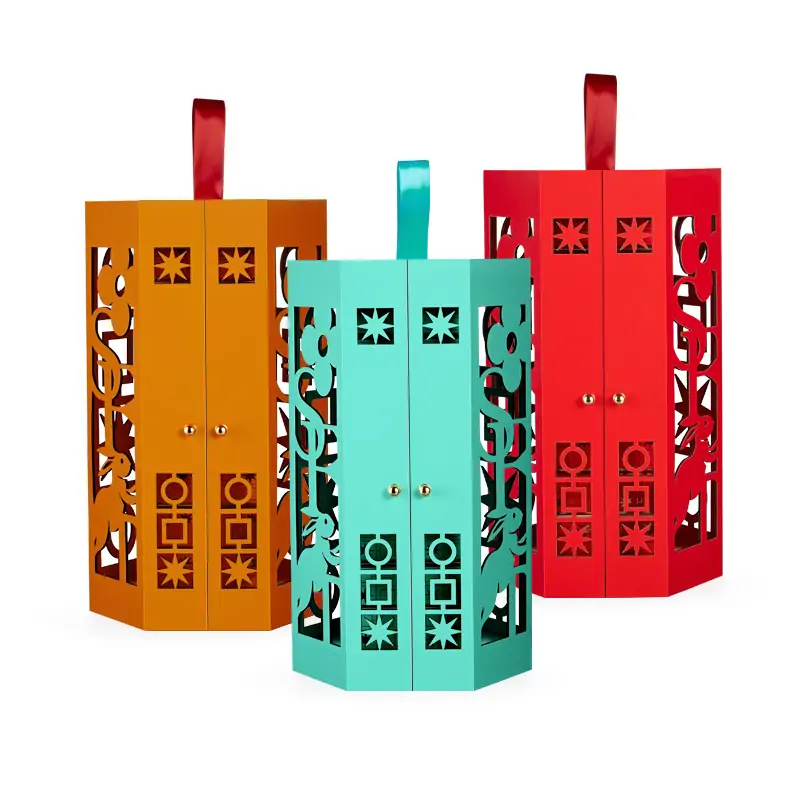
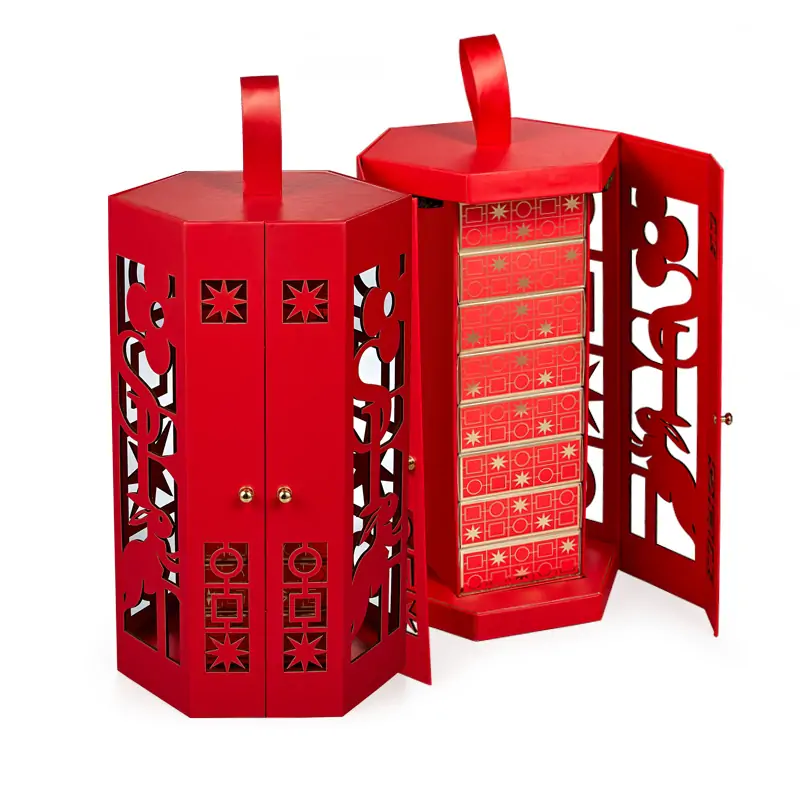
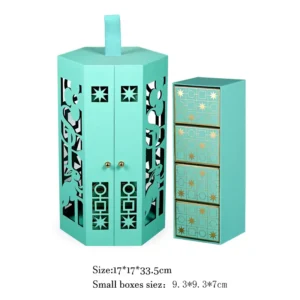
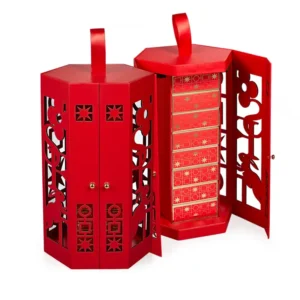
A lantern box is a gift box that has to look like an object, not a carton. This one is a hexagonal column with two doors down the front, laser-cut panels on every face, a ribbon handle on top, and four small drawers inside. It stands 33.5 cm tall and 17 cm across, and it takes a print on every surface that is not cut away.
What the lantern shape is made of
Six flat faces fold into a column, and the base and top cap close the ends. The edges of every cut face are visible on this box, which is why the board grade matters more here than on a solid box: an edge that shows a white core in the middle of a red panel is the first thing a buyer notices.
That is the difference between a lantern box that photographs well and one that looks cheap in the hand. On solid walls nobody sees the board. Here every opening exposes it.
The shape decides what the product can do. A six-sided column with openwork on three or four faces reads as a lantern at a metre away, and it does it without a bulb, a frame or a metal armature.
The doors and the two studs
The front two faces are separate panels that swing open like a cupboard. Two small rounded studs sit on the meeting edge and hold the doors shut.
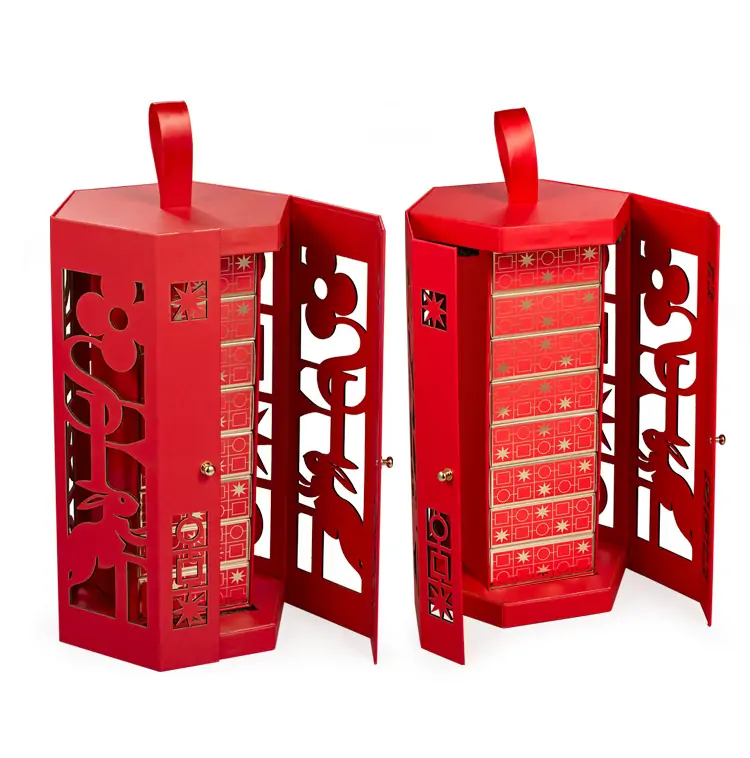
Pull the studs and the doors open flat, past ninety degrees, so the whole interior is visible at once. That is the moment the box is designed for: the person receiving it sees four drawers lined up rather than one dark cavity, and the gift inside is already sorted.
Laser cutting is where the design lives
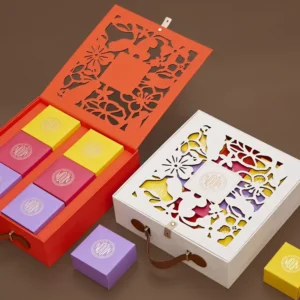
The panels are laser-cut, not printed. Each face has a zodiac animal, a window-flower motif and a coin pattern taken down to a lace of bridges and gaps. Laser cutting gives a hard, exact edge and allows shapes that a die would tear: the thin legs on a rabbit, the loops on a cloud, the inside of a coin’s square hole.
The pattern is set once. A new design means a new cutting file, and the file is the cost, not the material. Repeat orders on the same pattern carry no second setup, which is why the second season is always cheaper than the first.
Two limits worth knowing before you draw anything. Bridges between cut areas need a minimum width to survive handling, and every opening weakens the panel a little. A face that is 80 percent holes will not hold its line after a few weeks in a warm shop. Send the artwork and we will tell you where to open it up and where to keep it solid.
Four drawers inside one lantern
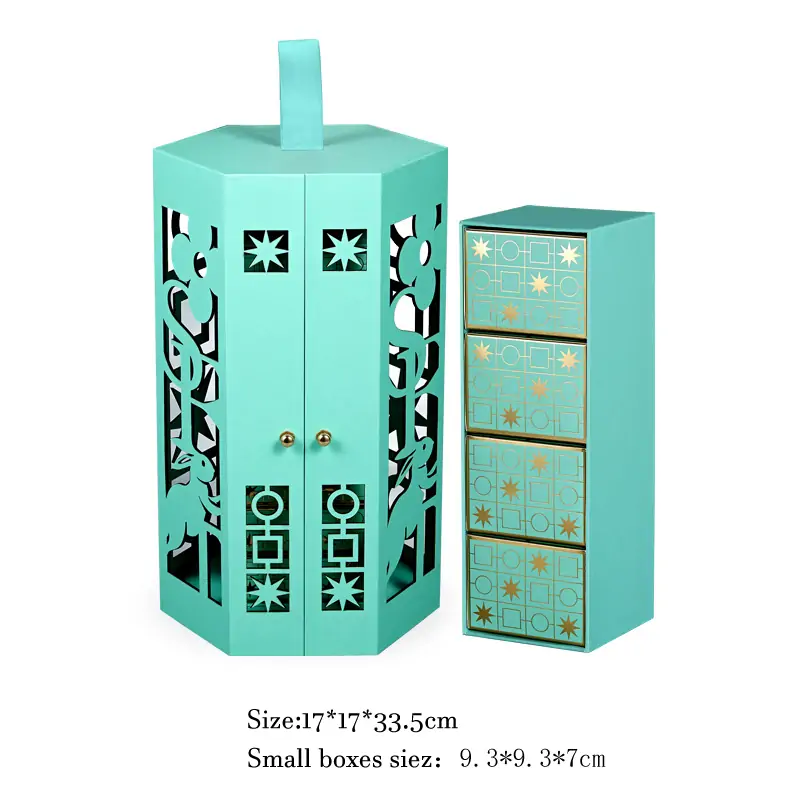
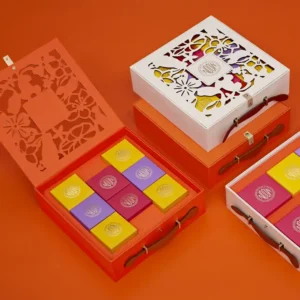
The inside holds four drawer boxes, each 9.3 cm square and 7 cm deep, stacked in a column behind the doors. Each one slides out on its own. For mooncakes, that is four cakes separated without a divider; for tea, four tins; for sweets or a small gift set, four compartments that keep the contents from knocking together in transit.
The drawers are the reason this shape works as a mooncake gift box at Mid-Autumn and as a hamper at Lunar New Year, rather than sitting as a decorative object. A lantern with one cavity is a pretty box. A lantern with four drawers is a gift that arrives organised.
The contents in our photos are not included. What ships is the lantern and its drawers.
The ribbon handle
A satin ribbon runs through the top cap and forms the handle. It is the one part of the box that is not board, and it does what the handle on a rigid gift box cannot: it flattens for packing and springs up when the box is carried.
Width and colour are yours to choose. A ribbon that matches the print disappears into the design; one in a contrast colour becomes the thing people notice first.
Where a lantern box earns its money
Mid-Autumn is the obvious season, and mooncake is the obvious content. The shape is also standard for Lunar New Year shop displays, where the same structure becomes a Chinese New Year gift box with different artwork, which means a brand can use one box across two festivals.
Wedding favour boxes work because the drawers split a gift into portions without extra packaging. Tea and coffee brands use the same drawers as a tea gift box, where four small tins need to look like one present. Corporate orders use it for client gifts in the 200 to 500 range, where the box has to survive a courier and still open on a desk without looking handled.
The shape also gets kept. A lantern that has held mooncakes becomes a lamp shade, a storage column, or a decoration that comes out again next year, and every one of those is a year of free brand exposure.
Sizes: 17 cm across, 33.5 cm tall
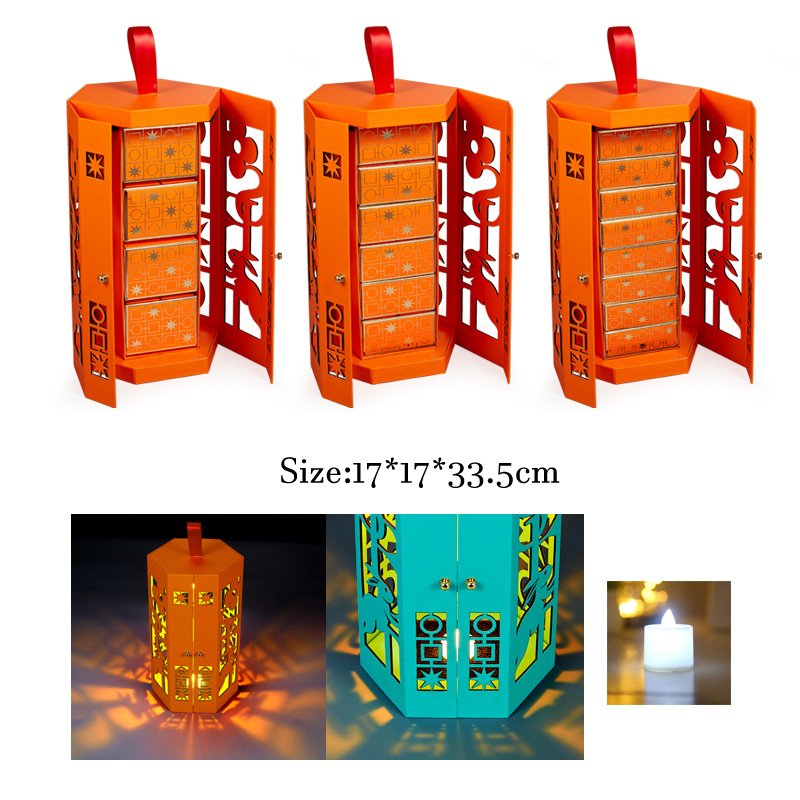
The standard lantern is 17 x 17 x 33.5 cm with four drawers at 9.3 x 9.3 x 7 cm. Both numbers can move, but they move together: a taller lantern needs a wider base or the column starts to lean, and a wider base needs deeper drawers to look right.
Send the size of what goes inside and we will work back to the lantern. Do not start from the lantern and hope the contents fit, because a drawer that is 2 mm shallow is a drawer that does not close.
Packing and freight
Thirty-three centimetres of height is a lot of air. How the lantern travels decides what the freight costs, so ask for the packing method with your quote rather than after you have booked a container. Boxes shipped standing up and boxes shipped broken down are very different numbers on a bill of lading, which is why collapsible rigid boxes exist for shapes this tall.
For a first order, check a carton of the finished thing before you commit to a packing method for the season, because how it opens after a month in a container is the only test that counts.
Printing and colour
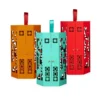
Every uncut surface takes print. Red, orange and teal are the three colours we run most for this shape, because they hold up under festival lighting and photograph well on a phone.
A single flat colour with cut panels is the cheapest strong version: the colour does the work and the cutting does the detail. A full-colour print on six faces costs more and, in our experience, reads worse at a distance, because the eye is already busy with the openings.
Pantone matching, matte or gloss varnish, and gold foil on the solid areas are all possible. Artwork should be vector with text outlined, drawn on our dieline.
What to check on the sample
Four things. Open and close the doors twenty times and see whether the studs still hold. Slide each drawer in and out and check that it does not catch on the cut edge. Hold the lantern by the ribbon and let it hang for a minute, because that is how it will be carried. Then stand it on a table and look at it from three metres, which is where a customer sees it in a shop.
If it fails the fourth test, the problem is the pattern, not the printing.
What to send us
Four things: the size, the artwork or the zodiac you want, the quantity, and the season you need it for. If the contents are already chosen, send their dimensions too.
Festival orders have a hard deadline that does not move, so tell us the date first. We will tell you straight whether the run fits.
FAQ
What is the lantern box made of? Board, cut and folded into a hexagonal column, with a satin ribbon handle and four drawer inserts.
How many drawers are inside? Four, each 9.3 x 9.3 x 7 cm in the standard 17 x 17 x 33.5 cm lantern.
Can the zodiac animal be changed? Yes. The cut pattern is a file, so a different animal, a logo, or your own motif replaces it. A new pattern means a new cutting file.
Does the box come with the mooncakes or tea inside? No. The lantern and its drawers ship empty. Contents in our photos are for scale.
Can it be printed in our own colours? Yes, Pantone matching is available, and the uncut faces take full print or foil.
How does it ship? Ask for the packing method with your quote, because a lantern this tall is mostly air and the answer changes the freight. Tell us whether you will pack it yourself or need it shelf-ready.
What is the minimum order? It depends on the pattern and the size, because the cutting file is a one-off cost. Send your quantity and we will quote against it.

Reviews
There are no reviews yet.