
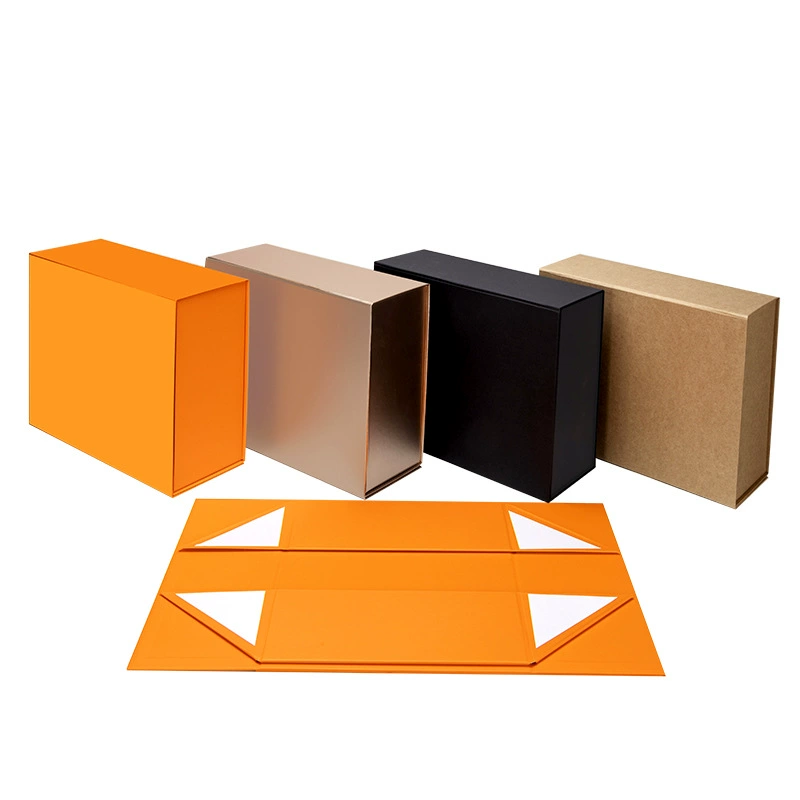
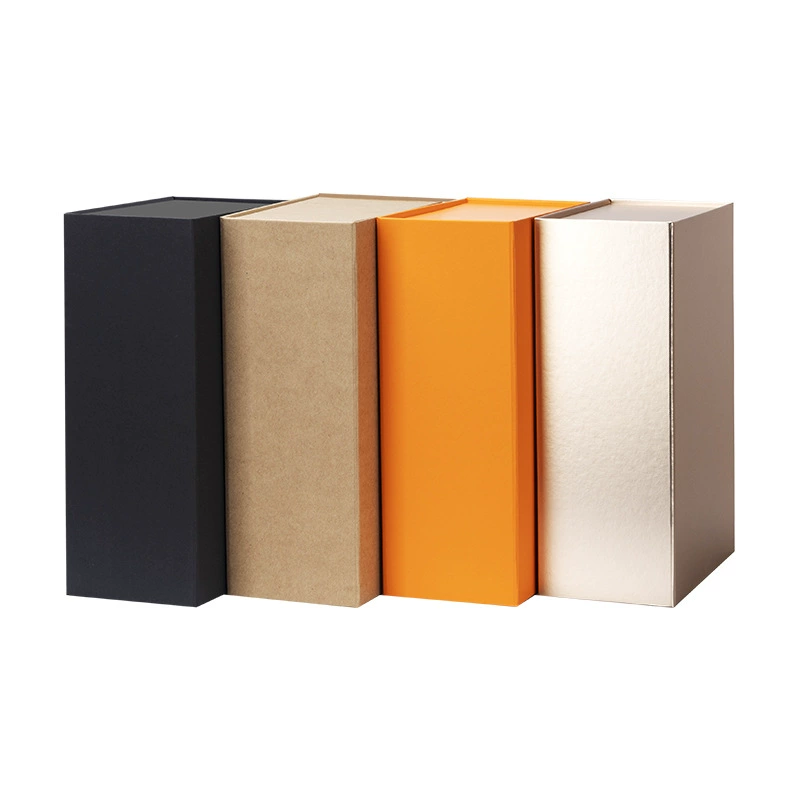
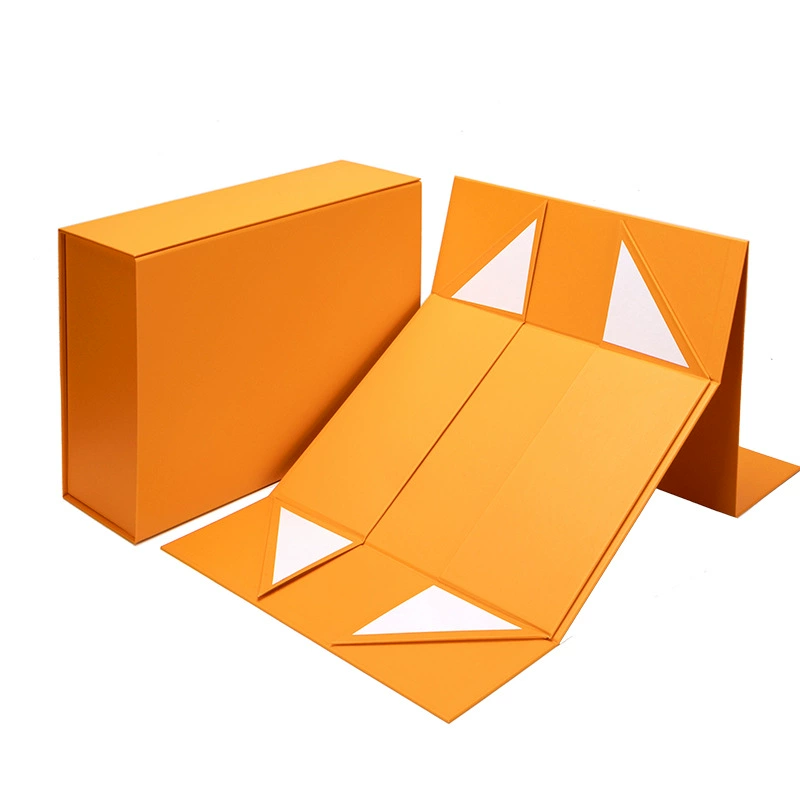
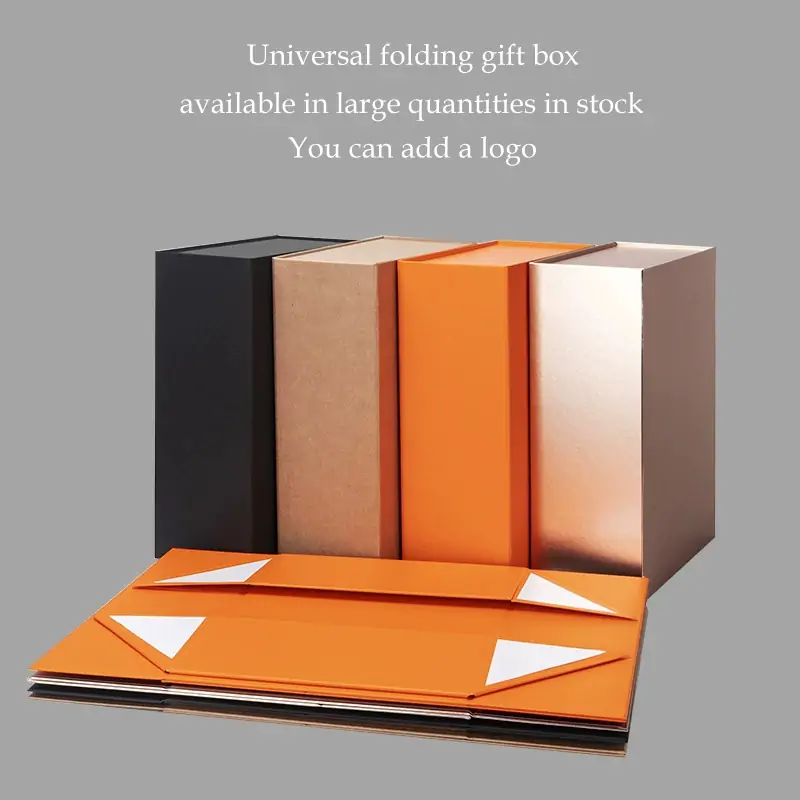
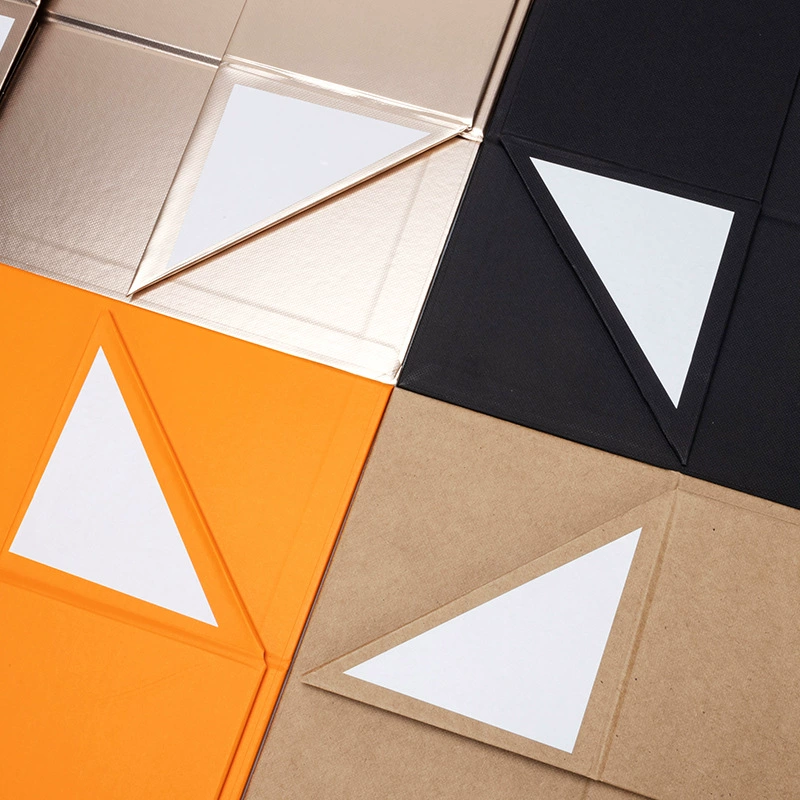
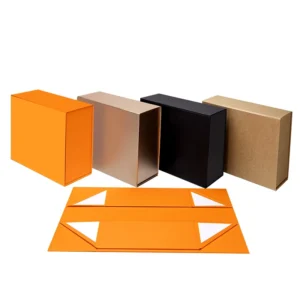
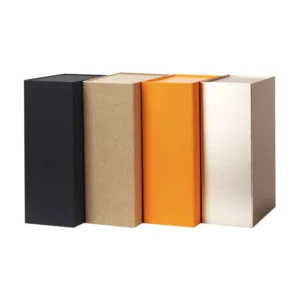
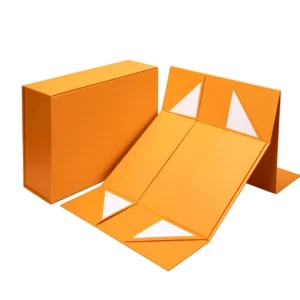
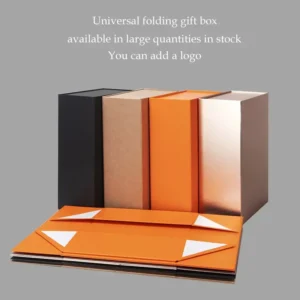
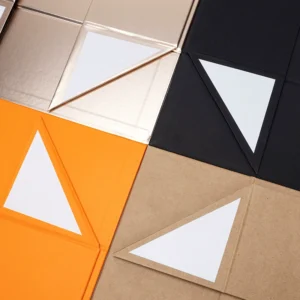
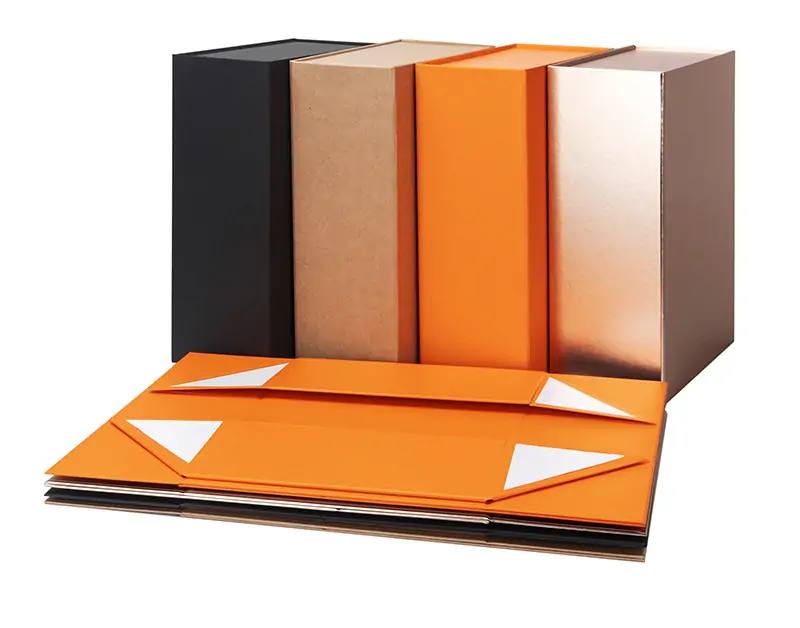
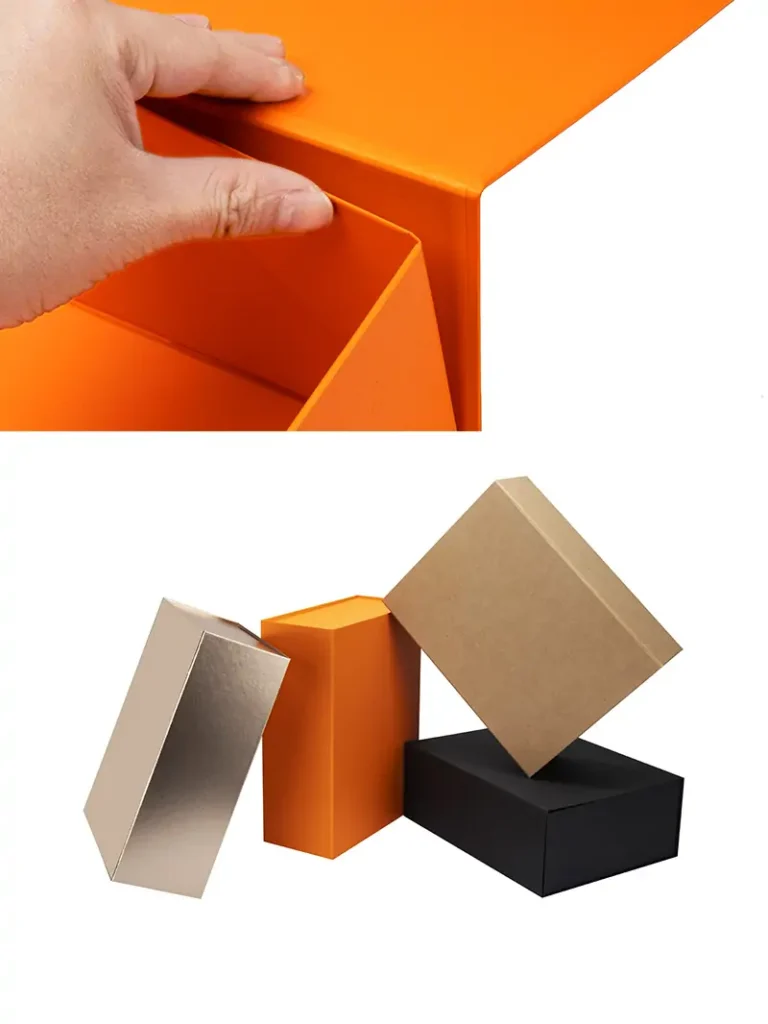
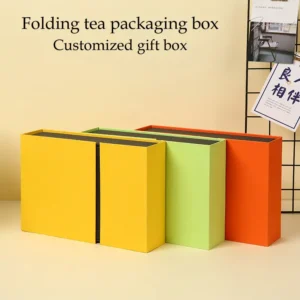
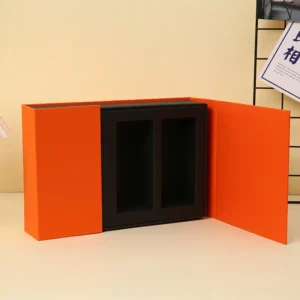
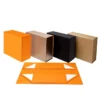
A one-piece collapsible gift box that ships flat and opens in a second. Standard board is 1200 gsm grey, wrapped in textured paper in orange, black, gold or kraft.
Specifications
| Item | Detail |
| Board | 1200 gsm grey board, wrapped in textured special paper, 2.0 mm thick |
| Structure | One-piece die-cut, folds flat, opens without glue or tape |
| Sizes (outer) | S 200 × 180 × 80 mm · M 280 × 200 × 90 mm · L 280 × 220 × 110 mm · XL 330 × 250 × 120 mm |
| Colours | Orange, black, gold, kraft; other colours matched to a Pantone number |
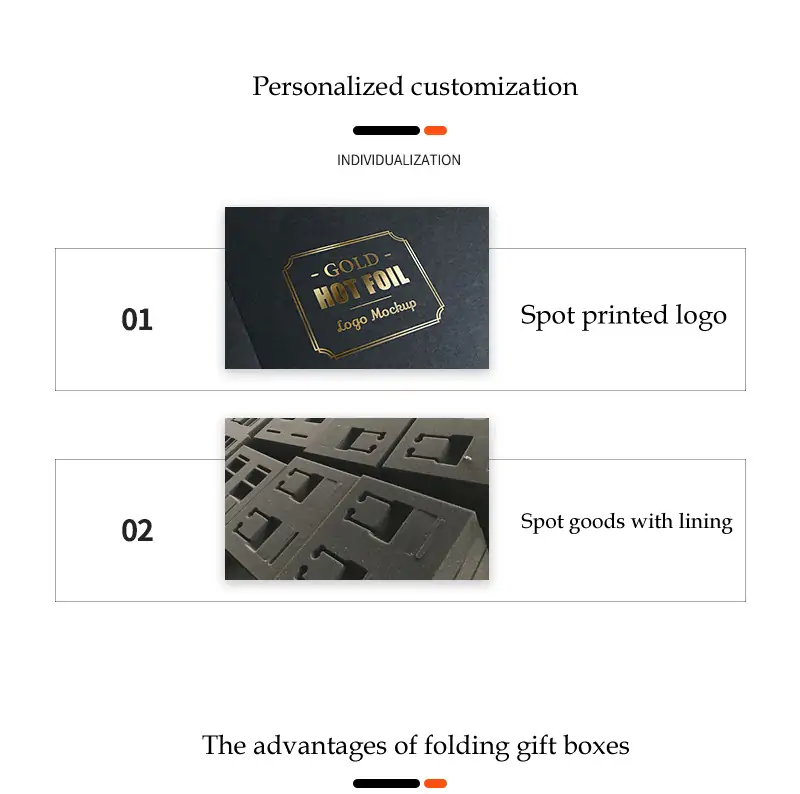
| Printing | Hot foil stamping, screen print, spot UV, full-colour paper wrap |
| Insert | Die-cut EVA or paper lining, on request |
| MOQ | 500 boxes per size and colour |
| Sample | 5 to 7 days |
| Production | 12 to 15 days after sample approval |
| Stock | None. Every box is made to order |
| Packing | 50 units per carton |
| Price | From $0.95 per box |
| Made in | Wenzhou, China |
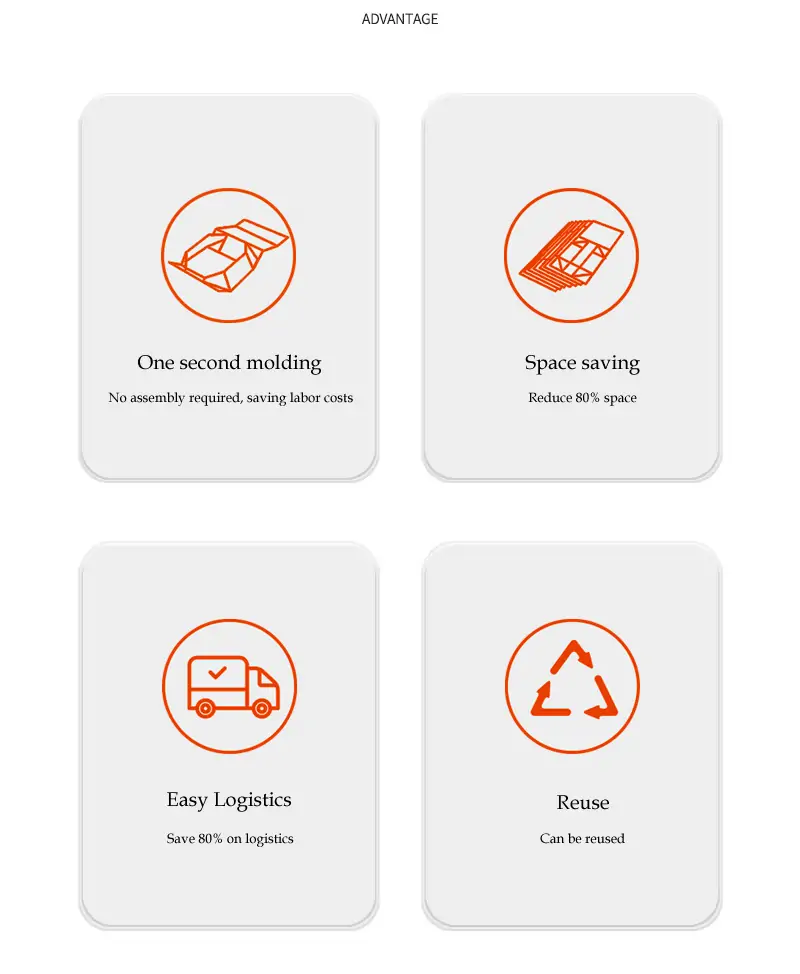
One piece, so it ships flat and opens in a second
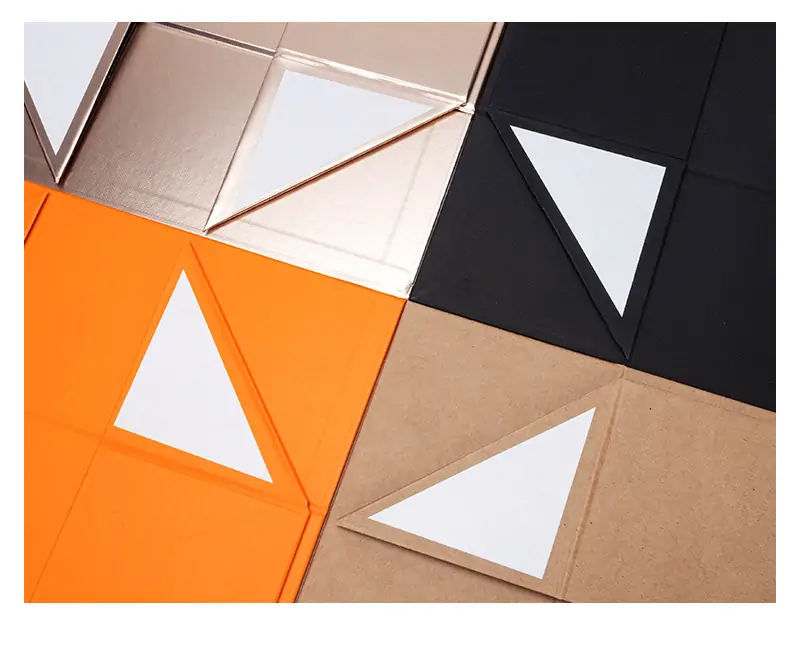
Most gift boxes are built as a base plus a lid, which means two die lines, two board thicknesses to control, and two stacks to keep matched on the packing table. This one is a single sheet. The corner tabs are glued to the wall at the factory and the whole thing folds along the paper hinge, so what arrives at your warehouse is a flat panel about 12 mm thick, not a hollow box.
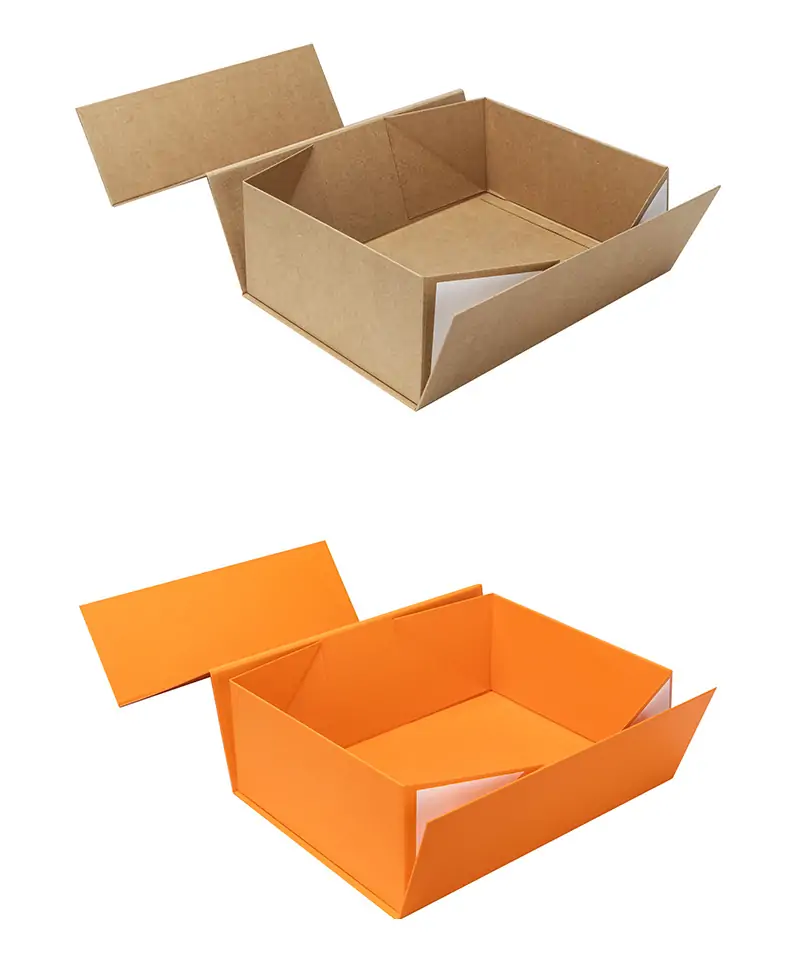
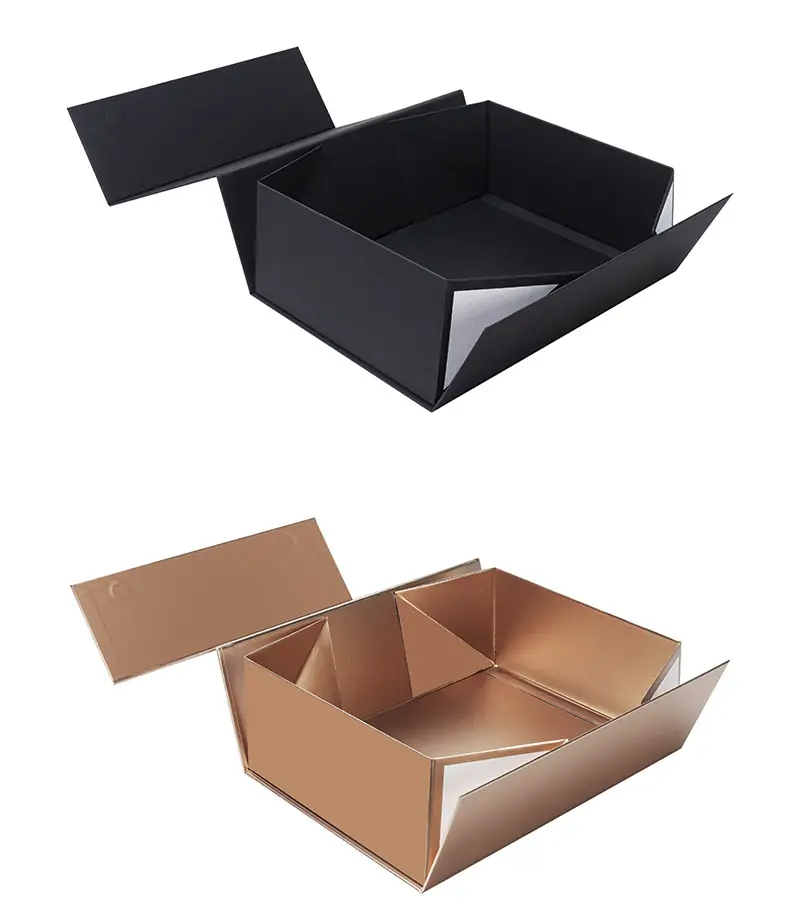
To use it, you push the four walls up and the lid folds over. One person can do it while packing, on the same table, without tape or a glue gun.
That matters more at volume than it sounds. If a packing team handles two thousand boxes in a day, “open it and fill it” and “fold it, glue it, hold it, wait for it to set” are two different staffing plans.
What 2.0 mm of grey board does
A thin folding carton holds its shape because it is small. A box at 330 mm has to hold its own shape while it is being carried, stacked and reopened, and that is where board thickness stops being a spec sheet number and turns into something a buyer can feel.
At 1200 gsm and 2.0 mm the walls do not bow when the box is lifted by one corner with something heavy inside. The lid does not sag into the opening on the second or third open. Nor does the wrap peel at the fold line, which is the usual failure point on cheap collapsible boxes: the board is thick enough, but the paper is thin and splits after a few cycles.
The kraft version shows the board edge on the inside, which some buyers want and some do not. If you are packing something light-coloured, the black or gold wrap hides scuffs better.
Four sizes, measured from the outside
| Size | Outer dimensions | What usually goes in |
| S | 200 × 180 × 80 mm | Scarves, small cosmetics sets, two or three jars |
| M | 280 × 200 × 90 mm | Candle plus matches, tea set, folded shirt, phone accessories |
| L | 280 × 220 × 110 mm | Bath set, two bottles, a mid-size hamper |
| XL | 330 × 250 × 120 mm | Apparel, gift sets with a book, boxed tableware |
These are outside dimensions. A box with 2.0 mm walls loses roughly 4 mm per side inside, so if your product is at the limit of a size, send us the actual pack dimensions and we will tell you whether it drops in or not.
If you need a size between two of these, the die can be adjusted, but expect a new die cost and a longer first run.
Orange, black, gold and kraft
The orange is a saturated signal orange, closer to a safety vest than to terracotta. It is the colour that photographs best on a marketplace listing, which is why most of our stock shots are orange.
Black and gold are the two that carry a printed logo without fighting it. Kraft is the cheapest of the four and the one buyers pick when the box is a shipping outer rather than the gift itself.
Any colour can be matched to a Pantone number, but none of them sit on a shelf waiting. A custom colour means a paper run, and paper has its own minimum order — usually more than the 500 boxes you need, so the balance stays with us for your next run. It also adds about a week before printing can start, on top of the 5 to 7 days for a sample.
The lining that stops things sliding
An empty box at 330 mm is a large space for a small product. A die-cut EVA insert or a paper platform holds the item in one place and makes the box look filled when the door is opened.
We cut the insert to the product, not to the box, so send a drawing or a sample of whatever goes inside. Paper platforms are cheaper and recyclable; EVA is firmer and survives being shipped repeatedly.
One thing buyers do not expect: an insert can be more expensive than the box itself when the shape is complex. For a simple rectangular item, a folded paper platform is usually enough.
How a flat box arrives without dents
Every box is bagged, then the edges get pearl cotton before the export carton is sealed. The edges are where a collapsible box fails, because the fold line is exposed until it is opened up.
If you are re-shipping boxes to your own customers, ask for the boxes to be bagged in tens rather than in one bulk bag. It costs a little more in packing time and saves a lot of scuffed corners.
Freight, and why flat packing matters
Freight is charged on volume, not on weight. A carton of assembled boxes is mostly air; a carton of flat boxes is mostly board. The same number of boxes takes a fraction of the container space, which is the whole reason this design exists.
We wrote the maths up separately in how folding boxes cut shipping costs, including the point where the saving stops paying for itself: very small orders do not benefit, because the carton handling is the same either way.
These boxes sit next to our rigid boxes and our standard folding cartons. If you are not sure which one your product needs, the difference is simple: rigid lids are set up and stay set up, collapsible boxes fold flat between runs, and thin cartons are the cheapest per unit.
MOQ, samples and lead time
Minimum order is 500 boxes, and that is per size and per colour. Two colours at 250 each is two runs and does not reach it, because the paper and the plate are set up separately for each. If you want to test two colours, the cheap way is 500 of one and a second run later.
A sample takes 5 to 7 days. That covers a plain sample in one of the four standard colours as well as a printed one. A printed sample is charged, because it needs a plate.
Production is 12 to 15 days after you approve the sample. A plain box at 500 sits at the short end; a foil-stamped box in the thousands sits at the long one. Adding a Pantone-matched colour puts about a week in front of that.
There is no stock. We do not keep finished boxes on a shelf. Every order is cut, wrapped and printed after you confirm, which is why the two numbers above are the whole timeline and not a starting point.
If you are working to a fixed date — a launch, a trade show, a seasonal window — count backwards from the day the boxes need to be in your warehouse, not from the day you order:
| Step | Days |
| Sample | 5 to 7 |
| Sample approval | yours |
| Production | 12 to 15 |
| Sea freight LCL | 16 to 30 |
| Total | 33 to 52 |
The freight line is the one that surprises people. Boxes are light and bulky, so they rarely fill a container on their own; most orders this size move as LCL, which means sharing container space and waiting for a sailing. Air freight is possible for a launch sample but rarely makes sense for 500 boxes.
So the practical version: roughly five to seven weeks from approval to your door. If your date is fixed, order the plain boxes early and print later if the artwork is not signed off — the box is the long lead item, not the logo.
FAQ
Does the box arrive flat or assembled?
Flat. Each box is a single panel with the corners already glued, and you open it up by pushing the walls out. There is nothing to assemble and nothing to tape.
How long does it take to open one?
About a second, once you have done a few. The fold line does the work; you are not fighting the board.
What is the minimum order? 500 boxes, per size and per colour. Two colours at 250 each is two print runs and does not reach it.
How long does an order take? A sample takes 5 to 7 days, then production is 12 to 15 days after you approve it. Freight is on top of both.
Do you keep boxes in stock? No. Every box is made to order, plain or printed. If you are working to a fixed date, count backwards from delivery and allow five to seven weeks.
Can I print a logo on a kraft box?
Yes, and kraft hides foil poorly. One-colour screen print reads best on kraft; gold foil on kraft looks muddy unless the foil is a matte one.
What fits in the M size?
A candle with a box of matches, a tea set for two, a folded shirt, or a phone and accessories with room around them. The inside is about 10 mm smaller on each side than the outside.
Do you make a magnetic or ribbon version?
Not in this construction. This box closes with a fold-over lid and has no magnet and no ribbon. If you need a magnetic closure, that is a rigid gift box, which is a different product and a different price.
If you want boxes for a specific product, send the dimensions and we will come back with the closest size and a price for your quantity. Every box is made to order, so the 5 to 7 days for a sample is the first step either way.
Reviews
There are no reviews yet.