
Mooncake Box Dimensions & Sizes: Complete Chart for 4, 6, 8 and 12 Pieces
Every year, right around the May lunar month, our inbox starts filling up with the same question. It is almost never about price, and rarely about lead time. It is this: what size box do I actually need?
Simple question. Complicated answer.
Last season a bakery in Johor ordered 800 rigid boxes built for 200 g mooncakes, then switched to a smaller 150 g recipe about three weeks before the festival. The boxes arrived on time and looked fantastic. The mooncakes also slid around inside every cavity like dice in a cup, and the entire run had to be remade at their cost. Nobody had measured anything — they had picked a box they liked the look of and assumed the rest would work out.
So let’s do this in the right order.
Start with the mooncake, not the box
This is the step almost everyone skips. People browse Pinterest, fall for a structure, and only afterwards check whether their product actually fits. That is backwards.
Measure your mooncake first. Everything else follows from that number.
| Mooncake weight | Typical diameter | Typical height |
| Mini — 50-80 g | 55-65 mm | 30-35 mm |
| Standard — 100-125 g | 70-75 mm | 35-40 mm |
| Standard — 150 g | 75-80 mm | 40-45 mm |
| Large — 180-200 g | 85-95 mm | 45-55 mm |
Two things worth knowing from the factory floor.
First, these are Cantonese-style numbers. Snow skin runs 10-15% smaller for the same weight because it holds more moisture, and Suzhou-style flaky mooncakes sit flatter and wider. If you are packing a mixed selection, size for the biggest piece and let the small ones share a cavity.
Second, measure the wrapped mooncake. Almost every commercial mooncake goes into a sealed pouch or a small plastic wrap before it ever touches the box, and that film adds 3-5 mm on each side. Manufacturers who measure the bare pastry end up with cavities that are 6-10 mm too small, and the wrapping gets creased during packing.
The complete mooncake box size chart
Here is the chart we send to customers who ask. All figures are external dimensions in millimetres, lid included.
| Pieces | Layout | Compact (50-80 g) | Standard (100-150 g) | Premium (150-180 g) |
| 1 | Single | 100 × 100 × 50 | 110 × 110 × 55 | 120 × 120 × 60 |
| 2 | 2 × 1 | 150 × 100 × 50 | 170 × 110 × 55 | 190 × 120 × 60 |
| 4 | 2 × 2 | 175 × 170 × 50 | 200 × 200 × 60 | 235 × 235 × 65 |
| 6 | 3 × 2 | 250 × 170 × 50 | 290 × 195 × 60 | 325 × 245 × 62 |
| 8 | 4 × 2 | 328 × 173 × 53 | 380 × 195 × 60 | 420 × 280 × 75 |
| 12 | 4 × 3 | — | 380 × 290 × 60 | 400 × 300 × 80 |
Three columns, because “6-piece box” on its own tells you nothing. A 6-cavity box for mini mooncakes and a 6-cavity box for 180 g mooncakes differ by 75 mm in width. Always specify weight alongside count when you send an enquiry — it will save you a round of emails.
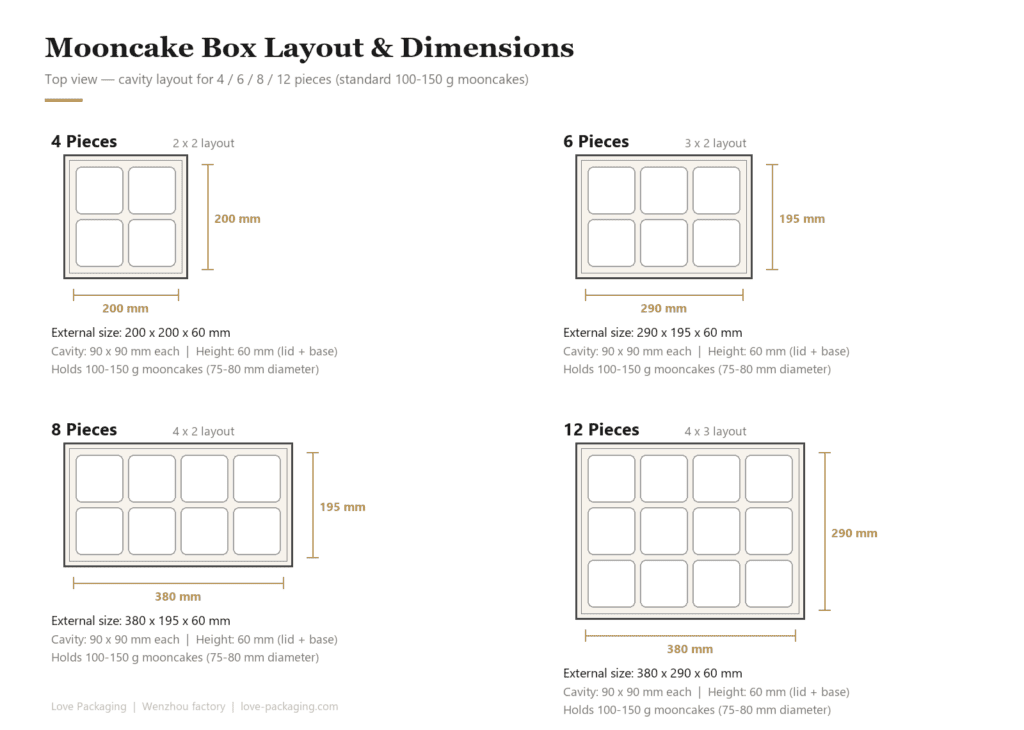
4-piece boxes (2 × 2 layout)
The 4-piece box is the smallest size that still reads as a gift. Two rows, two columns, usually a rigid lid-and-base construction with a moulded insert.
Standard size runs 200 × 200 × 60 mm for 100-150 g mooncakes. The compact version at 175 × 170 × 50 mm suits mini mooncakes and works well for office distribution, where one box gets shared between four people at a desk.
This is also the size most Singapore hotels use for their corporate gifting tier — big enough to feel considered, small enough to stay under a gifting budget threshold.
Practical note: a square 4-piece box is far easier to ship than a long thin one. If your mooncakes are going out by courier, keep the footprint square. Tall narrow boxes tip over in transit and arrive with crushed corners.
6-piece boxes (3 × 2 layout)
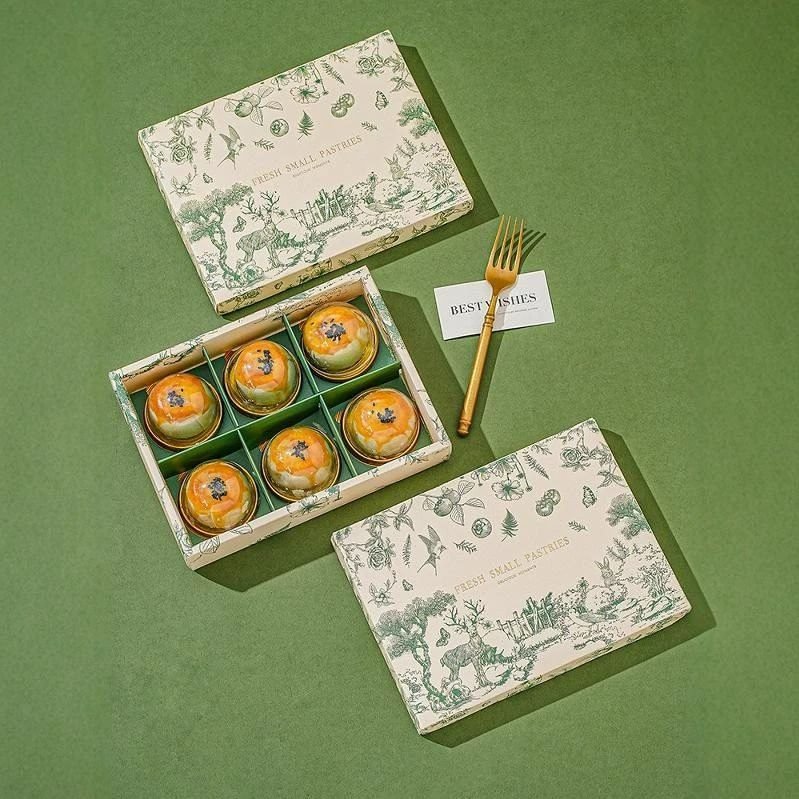
Six is the single most requested quantity we produce. It bridges the gap between a personal gift and a family sharing box, and the 3 × 2 layout keeps the footprint compact enough to fit inside a standard gift bag.
Standard size: 290 × 195 × 60 mm. Premium rigid versions run closer to 325 × 245 × 62 mm once you add a thicker greyboard wall and a proper lid overhang.
Practical note: if you plan to bundle the box with a carry bag, decide that now, not later. A 290 mm box needs roughly a 320 × 240 mm bag to drop in comfortably. Getting the bag sized after the boxes are printed is how you end up paying for a second tooling run.
8-piece boxes (4 × 2 layout)
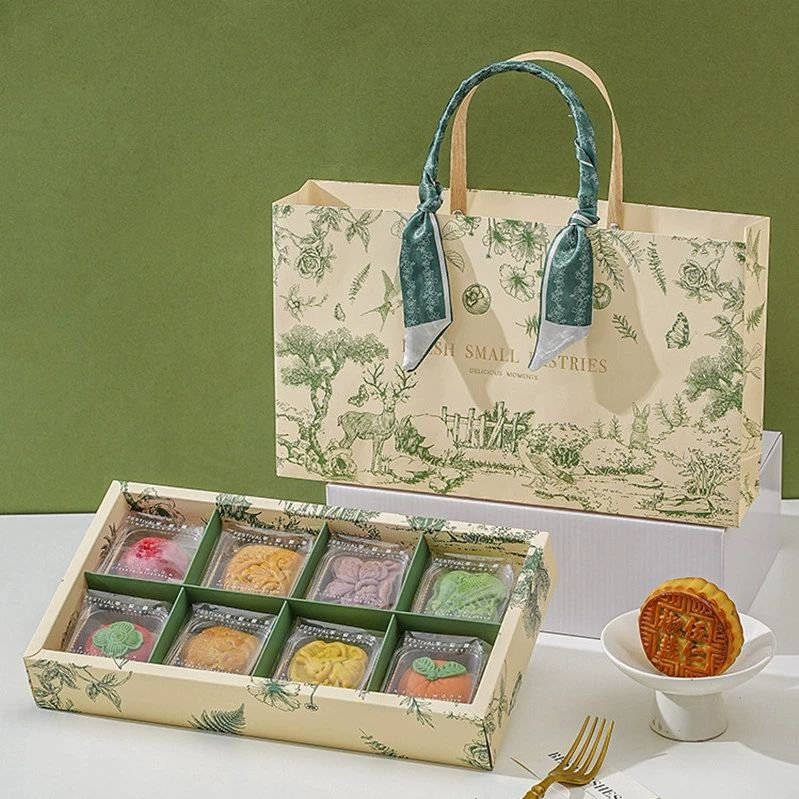
Eight is the corporate and bulk-gifting size. The 4 × 2 layout keeps the box long and flat, which looks generous on a table and photographs well for social media.
Standard size: 380 × 195 × 60 mm. Premium versions with heavier board and a magnetic closure push out to 420 × 280 × 75 mm.
Practical note: an 8-piece box is the point where weight starts to matter. Eight 150 g mooncakes plus a rigid board shell lands around 1.6-1.8 kg before you add a bag. Check your courier’s tier boundaries before finalising the count — sometimes dropping to 6 pieces keeps you inside a cheaper shipping bracket, and the saving per unit is bigger than the cost of the two mooncakes you removed.
12-piece boxes (4 × 3 layout)
Twelve-piece boxes are almost always corporate. Banks, property developers, and hotel groups order these in the hundreds for staff distribution and client gifting.
Standard size: 380 × 290 × 60 mm (4 columns, 3 rows). Premium versions go to 400 × 300 × 80 mm and often include a separate tier or a drawer for tea or cutlery.
Practical note: at this size the lid starts to bow if the board is too light. We use 1200 g greyboard minimum for anything above 380 mm on the long edge. If a supplier quotes you a 12-piece box at a suspiciously low price, ask what board weight they are using. It is usually the first place corners get cut.
Single and double boxes
Not every order is a gift set.
Single boxes run 100-120 mm square and about 50-60 mm tall. Bakeries use them for individual retail sales and for the “one to try” tier. They are also the cheapest way to test a new recipe — order a few hundred, see how it sells, then scale into a 4- or 6-piece set.
Double boxes sit at 150 × 100 mm for minis, up to 190 × 120 mm for standard sizes. Two-piece boxes are popular as a low-commitment corporate gift and as a hotel turndown amenity during the festival week.
The clearance rule that saves your mooncakes
Here is the number most suppliers will not volunteer.
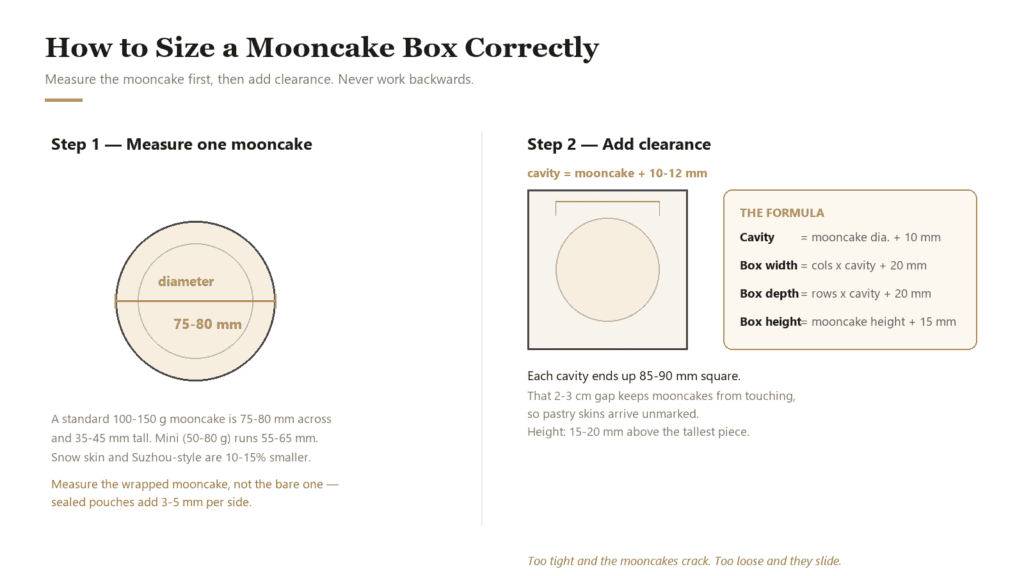
Each cavity should measure roughly 10 mm wider than the mooncake diameter. So a 75-80 mm mooncake needs an 85-90 mm square cavity. That works out to 2-3 cm of dead space between any two mooncakes once you count the partition walls.
Two reasons. Mooncake pastry is delicate — the lye water in the skin makes the surface prone to chipping, and any movement in transit leaves marks. And in Singapore and Malaysia, where boxes often travel by car for an hour in humid air, a tight cavity means the pastry swells against the wall and tears when the box is opened.
Height matters more than you think
Most enquiries specify width and depth only. Height is where the expensive mistakes live.
The rule: box height should exceed your tallest mooncake by 15-20 mm.
Below that, the lid presses on the pastry and produces a ring of crushed pattern on the top of every mooncake in the box. Above that, mooncakes shift vertically during transit and the patterned surface gets scuffed.
The 60 mm working height in our chart assumes a 40-45 mm mooncake plus a 2-3 mm tray base and a 12-15 mm air gap. If you are packing 180 g pieces at 50-55 mm tall, you need 70 mm minimum — and that is a different box, not a tweak.
When standard sizes don’t work
Roughly one in ten orders needs something off-chart. Three situations come up again and again.
Mixed assortments. A box with two 150 g mooncakes and four minis cannot use a uniform grid. We cut custom cavities in the tray so each piece sits snug, and the box stays rectangular.
Non-round mooncakes. Heart shapes, squares, and the occasional novelty mould all need their own tray geometry.
Added contents. Tea tins, cutlery, a sleeve of vouchers. Anything extra shifts the internal layout and usually pushes the box up one size tier.
In all three cases the process is the same: send us the actual spec of what goes inside, including packaging film, and we will draw the dieline before anything is quoted. Our custom mooncake box page has the full structure range, and the folding mooncake box option is usually the right call if you are shipping in volume and want to cut freight cost.
Frequently asked questions
What is the standard size of a mooncake box?
For a 4-piece box with standard 100-150 g mooncakes, the widely used size is 200 × 200 × 60 mm. For 6 pieces it is 290 × 195 × 60 mm, and for 8 pieces 380 × 195 × 60 mm. These are external dimensions in millimetres, lid included.
How big is a mooncake?
A standard Cantonese mooncake weighing 150 g measures roughly 75-80 mm in diameter and 40-45 mm tall. Mini mooncakes of 50-80 g are about 55-65 mm across. Snow skin varieties run 10-15% smaller for the same weight.
How much space should be between mooncakes in a box?
Allow about 10 mm of extra diameter per cavity, which gives 2-3 cm of clearance between any two mooncakes. This prevents the pastry from touching or rubbing during transport.
What is the MOQ for custom mooncake boxes?
Our standard minimum is 1,000 pieces per design. For smaller runs, the dessert box style shared across several products is often a better use of budget than a dedicated mooncake box tooling.
How early should I order mooncake boxes?
For delivery to Singapore or Malaysia, we recommend confirming artwork by the end of the fourth lunar month. Production takes 10-14 working days, and sea freight adds 7-12 days. The last two weeks before the festival are when every factory in the region is fully booked — that is not the moment to be negotiating a new dieline.
Not sure which size fits?
Send us your mooncake dimensions — weight, diameter, and height, wrapped — plus how many pieces you want in a box. We will come back with a recommended size and a dieline drawing, usually within one working day.