
Every year in the second week of November we get the same email. A gift brand in Singapore or Kuala Lumpur has finished its hamper contents, booked the marketing shoot, and now needs 3,000 printed Christmas boxes. The date is 12 November. Christmas is 25 December. That leaves 43 days — and about 40 of them are already spoken for by the factory, the port and a container ship.
Christmas packaging lead time is the one number buyers most often underestimate. It is rarely the printing that catches people out. It is the two steps on either side of it — the artwork sitting in someone’s inbox, and a sailing that slipped by four days in November.
This post is the answer we send back. It covers where the weeks actually go, the cut-off dates for Christmas 2026, and what you can still do if you are reading this in November.
The short answer
For a custom printed box shipped by sea from Wenzhou to Singapore, count back six to nine weeks from the day you need stock on the shelf — that is the full-container figure. If your quantity is small enough to travel as a shared container (LCL, sometimes called groupage), add another one to two weeks on top, so seven to eleven weeks.
Most Christmas orders under about 3,000 pieces do travel as LCL. That extra fortnight is the single most common reason a well-planned order still lands late.
Either way, early November is the line where you stop planning and start paying — for expedited production, for air freight, or both.
Where the six to nine weeks actually go
Buyers usually imagine the timeline as “print the boxes, put them on a boat”. It is five separate steps, and two of them are outside the factory.
| Dieline and artwork sign-off | 3–7 days | You |
| Sampling — blank or printed | 5–7 days blank, 10–12 days printed | Factory |
| Your approval round trip | 3–7 days | You |
| Production | 15–25 days | Factory |
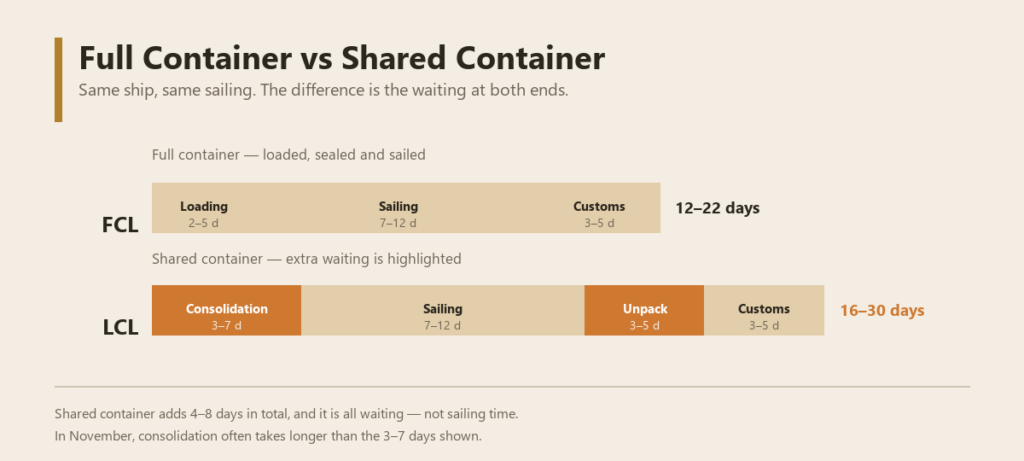
| Sea freight — full container (FCL) | 12–22 days door to door | Shipping line |
| Sea freight — shared container (LCL) | 16–30 days door to door | Forwarder |
Both freight rows include customs clearance and final delivery, so there is nothing to add after them.
Why the two differ. A full container is loaded at our factory, sealed, and sails. A shared container waits at the consolidation warehouse until there is enough cargo to fill it — three to seven days, sometimes longer in November when everyone is shipping — and then has to be unpacked and sorted at the other end before your cartons are released. Same ship, same seven-to-twelve day sailing. The difference is the waiting on both sides of it.
Which one you get is mostly a question of volume. Gift boxes are bulky, so it takes a surprising quantity to fill a 20-footer; anything under roughly 3,000 pieces usually goes LCL. Ask your forwarder to quote both once you are above a pallet or two — occasionally a part-loaded container is only marginally more expensive and a fortnight faster, which at Christmas is worth a lot.
Add the low ends with FCL and you get 38 days. Add the high ends with LCL and you get 81. That is the range behind “six to nine weeks for a full container, seven to eleven for a shared one” — and it assumes nothing goes wrong.
Production is the widest row for a reason. Fifteen days is a clean run: one board, one print, one finish, no surprises. Twenty-five is what happens when you add a second foil pass, a custom insert tray, or a hand-assembly step at the end. From October onwards we also quote on the longer side, because the line is busier and a reorder for one client pushes everyone behind them by a day or two.
Two of those six rows are yours, not ours. In practice the approval round trip is where most Christmas orders lose their buffer — not because anyone is slow, but because the sample arrives on a Thursday and the person who needs to approve it is at a trade show until Tuesday.
Cut-off dates for Christmas 2026
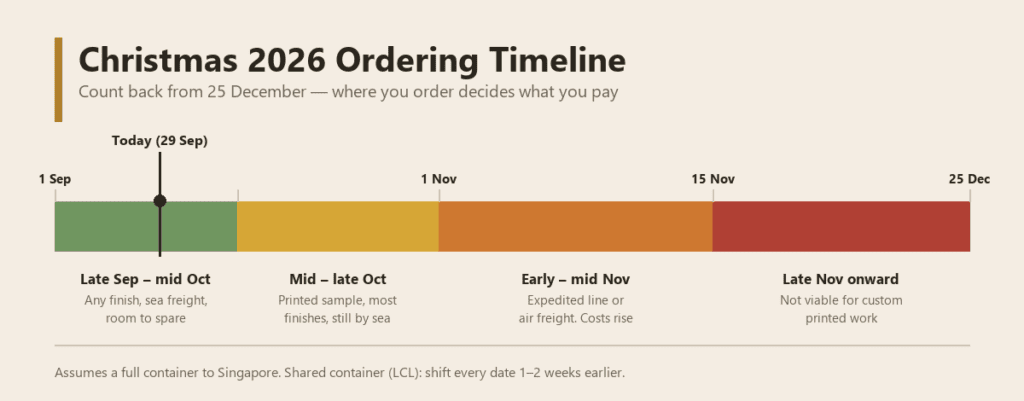
Christmas Day 2026 is Friday 25 December. Here is what each start date buys you.
| Late September | Full sampling, any finish, sea freight, buffer to spare | None |
| Mid-October | Printed sample, most finishes, sea freight | Low |
| Late October | One sample round, simpler finishes, sea freight | Moderate |
| Early November | Expedited production, limited finishes, sea freight is tight | High |
| Mid-November | Air freight is the only realistic option | Very high — cost jumps |
| Late November onward | Not viable for custom printed work | Save it for next year |
The honest version: late October is the last date we would call comfortable, and mid-October is where we would want to be. If your shipment goes as a shared container, shift every row in that table one to two weeks earlier.
One thing worth saying plainly: these dates assume you are shipping to Singapore or West Malaysia, as a full container. Two adjustments if not — add one to two weeks for LCL, and another week if the stock is going onward to Indonesia, Vietnam or the Philippines.
If you are reading this on 29 September, you are in the best possible position. You have roughly three weeks of slack before things start costing extra.
What happens if you order in November
Three options, in ascending order of pain.
Air freight instead of sea. Cuts the 7–12 day sailing to 3–5 days in the air. It works, and we do it every season for somebody. The freight bill is where it hurts — air typically runs several times the sea rate on a per-kilo basis, and packaging is bulky, so you feel it. Ask your forwarder for a real number before you commit; we can quote both ways.
Simplify the box. Every extra finish is another station, another queue, another day. Dropping a second foil colour or switching from a rigid setup to a folding carton can take a week off production. Our folding boxes also pack far flatter, which means more units per carton and a lower freight bill even by sea — worth knowing if you are watching both the clock and the budget.
Split the order. Air freight 20–30% of the quantity to cover your launch and first week of sales, then send the rest by sea. You pay a premium on a small batch instead of the whole run. This is the move most of our repeat customers make when they have left it late.
Three things that quietly eat a week
These are the delays that catch people out, because none of them appear in a quote.
A dieline revision. The first dieline rarely fits your product perfectly. If you are packing six items into a hamper and the tray positions shift, that is another 2–3 days before the sample can even be cut. Send us actual product dimensions up front, not a guess.
Shipping the sample back and forth. A printed sample is the only way to really judge foil on a red board. But posting it, reviewing it, and coming back with changes is a week in itself. Some clients approve from photos to save the round trip — fine for a repeat design, risky for a new one.
Peak-season sailings. From October onwards, space on the Wenzhou–Singapore route tightens and sailings slip. The 7–12 day range we quote in August quietly becomes 12–18 in November. Book the container when you approve the sample, not when production finishes.
How to compress the timeline without cutting corners
Reuse an existing dieline. If you ran a similar box last year, we very likely still have the die. That removes the tooling step entirely and saves the tooling fee. Worth asking before you design something new.
Skip the blank sample. A blank sample tells you about structure. A printed one tells you about structure *and* colour *and* finish. If you are short on time, go straight to the printed sample and accept that you will be checking both at once.
Freeze the artwork once. The single biggest schedule killer is a logo change after production starts. Get sign-off from everyone who needs to approve it — including the person who is travelling — before we cut the plates.
Order a sensible quantity. Our minimum is 500 pieces. Going well above the minimum does not extend the timeline much, so if you are unsure between 3,000 and 5,000, the bigger number costs you a few days at most and saves a second run later. You can read more about how we handle smaller runs in our post on low-MOQ custom packaging.
What we need from you to start
Four things, and we can have a dieline back to you within a couple of days:
- What goes inside the box — dimensions, or better, the actual items
- Roughly how many you need
- Which finish you have in mind (hot foil, emboss, print, or a combination)
- Your artwork, in vector if you have it
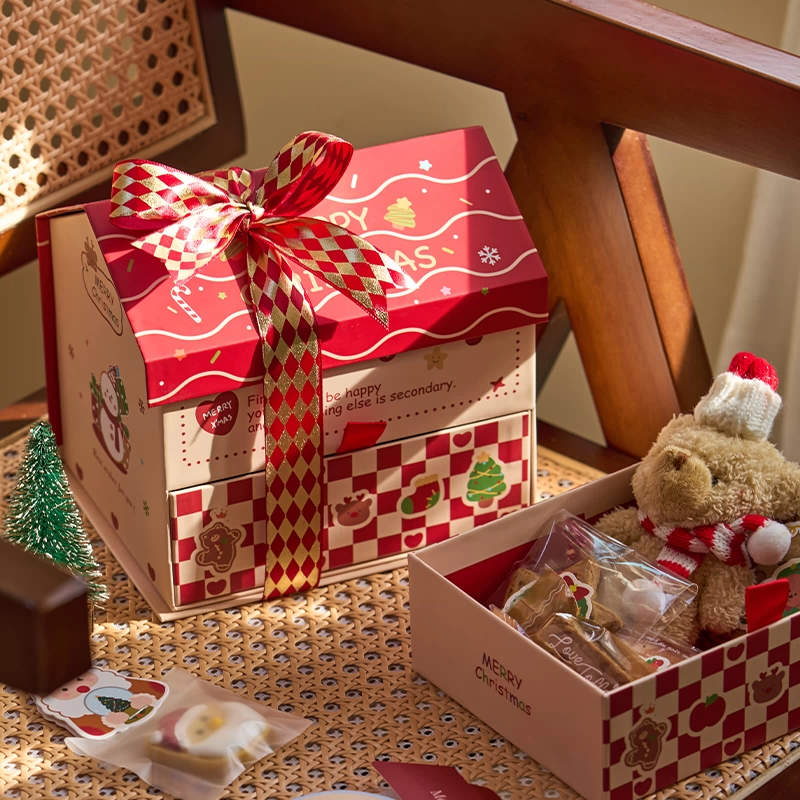
If you already know the format you want — a rigid gift box, a house-shaped Christmas box, a folding carton — tell us and we will quote against it directly. If you are still deciding, our custom gift box range covers the shapes we run most often at Christmas.
And if none of those fit, send us a photo of what you have in mind. Half the Christmas boxes we make started as a screenshot from a client’s Pinterest board, and a reference image gets us to a dieline faster than a paragraph of description ever does.
FAQ
What is the real cut-off date for Christmas 2026?
Late October for a comfortable sea-freight run. Mid-October if you want slack for a sample revision. After early November, plan on air freight.
Can I still order in November?
Yes, but air freight is the realistic option and it adds meaningfully to your landed cost. Tell us your deadline first and we will tell you honestly whether it works.
How long does sampling take?
5–7 days for a blank structural sample, 10–12 days for a printed sample with your artwork. We print and mount a short run rather than mock one up, so what you see is what the production line will make.
What is the MOQ?
500 pieces per design. Sizes and colours can be mixed to reach it, which is useful if you are running several hamper sizes on the same print.
Will my order go as a full container or a shared one?
Below roughly 3,000 pieces, almost certainly shared (LCL). That is fine, it is how most festive orders travel — just budget the extra one to two weeks. We will tell you the volume of your finished order in cubic metres when we quote, so your forwarder can price both options.
Can I reuse last year’s die?
Often yes. We keep dies from previous runs. If yours is still on the shelf you skip the tooling step and the tooling fee — ask us and we will check.
Do you ship outside Singapore?
Yes. We ship across Southeast Asia and worldwide. Transit times vary by port, so tell us the destination and we will quote with freight included.
—
Send your box dimensions and what goes inside to jordan@lovepacking.cn, or WhatsApp 8615757775322, and we will come back with a dieline and a landed price within 24 hours. If you are reading this in October, now is the week to do it.