
A bakery in Kuala Lumpur sent us a kraft box sample last September and asked us to copy it exactly. Nice looking box. Uncoated brown board, one-colour print, minimal design. Very on-brand for what they were doing.
Three weeks into the festival run, they called back. Every box in the top layer of the carton had a dark ring on the lid, right above where the mooncake sat. Oil. Their lotus paste was migrating straight through the uncoated kraft board, and it showed up in about 48 hours.
The material was not wrong. The material plus the pastry was wrong. Nobody had tested the two together.
That is the whole problem with choosing a mooncake box material. Every supplier page lists cardboard, rigid, tin and kraft as if they were interchangeable, and then you pick the one that photographs best. Mooncakes are not a neutral product to pack. They are heavy, they are oily, they sit in a box for two to four weeks in humid air, and the box is usually a gift that someone keeps.
Here is how the four materials actually behave, with the numbers we work with in the factory.
Start with the pastry, not the material
Before you look at a single sample, three properties of your mooncake have already eliminated some of your options.
Weight. A 4-piece box of 150 g mooncakes is 600 g of product, plus the tray, plus the box itself. Call it 800 g. A 12-piece set crosses 2 kg before you add a bag. Thin board is not a style choice at that weight, it is a structural failure waiting to happen.
Oil. This is the one nobody warns you about. Lotus paste, salted egg yolk and five-kernel fillings all release oil over time. On a coated or laminated board it wipes off. On an uncoated board it soaks in and stays. If you are considering kraft for a mooncake box, this single fact decides your construction.
Moisture direction. In Singapore and Malaysia the box goes from an air-conditioned shop into a humid car boot and back. If it then travels by sea freight, it sits in a container for a week. Board takes on moisture and swells; that is why the cavity clearance in our mooncake box size chart is 10 mm wider than the mooncake, not 3 mm.
Get these three right and the material choice becomes straightforward.
Cardboard (folding carton board) — the default for a reason
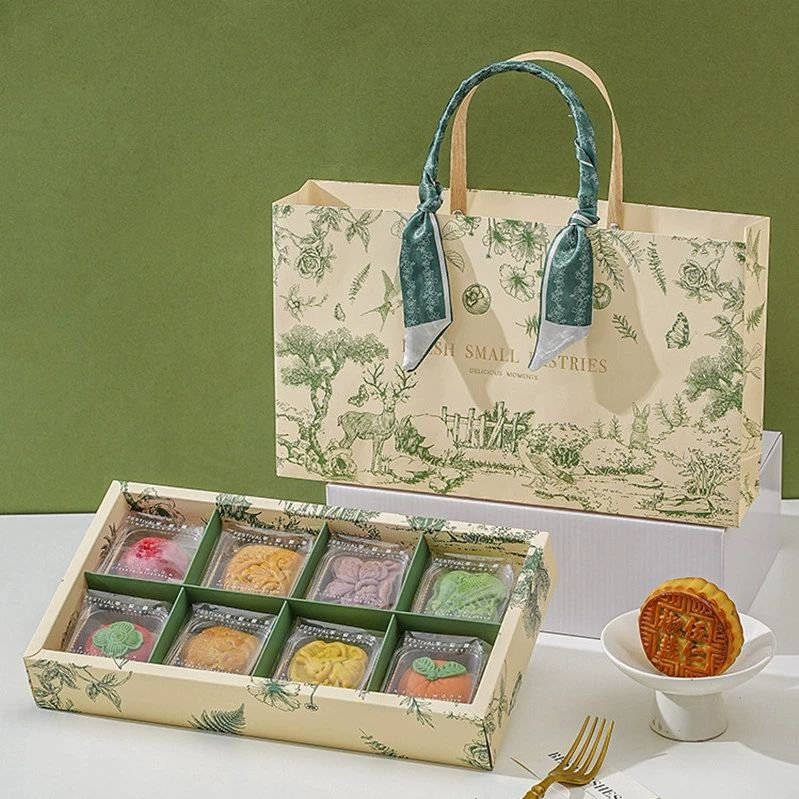
This is what most mooncake boxes in the market actually are, even the ones that look expensive. A flat sheet of 300-400 gsm folding board, die-cut, folded, glued, and shipped to you flat.
The wall is 0.43 mm thick. Printed and laminated surface on the outside, 350 gsm.
The reason it dominates is not price, although the price is good at around $0.55 per box at 3,000 pieces. It is the printing. White folding board takes full-colour offset and CMYK artwork the way a magazine page does. Deep navy, pastel gradients, fine gold line art — all of it lands. Try the same artwork on brown kraft and you will see what I mean.
The second reason is freight. Folding boxes are shipped in flat packaging, and it takes several minutes and effort to package each box. A 40HQ container holds roughly five times as many flat cartons as the same number of assembled rigid boxes. At 5,000 units to Singapore, that difference is usually larger than the entire unit-cost gap between the two materials.
Where it fails. Under 300 gsm, a 6-piece box feels flimsy in the hand and the corners crush in a mailer. Over about 380 mm on the long edge, a single-wall folding carton lid starts to bow unless you go to E-flute corrugated. And the oil problem is real: uncoated or varnished-only carton board will show oil marks. Use a laminated or PE-coated surface, or put a greaseproof liner under the tray.
A note on cheap quotes. If a supplier quotes you a folding mooncake box well under $0.40 at 1,000 pieces, ask what board weight they are using. Going from 350 gsm to 250 gsm saves them real money and costs you the corner strength. It is the first corner that gets cut, and it is invisible in a photo.
Best for: 4 and 6-piece bakery gift sets, retail counter sales, anything where the print design is the selling point.
Rigid greyboard — the premium default, and the heaviest one
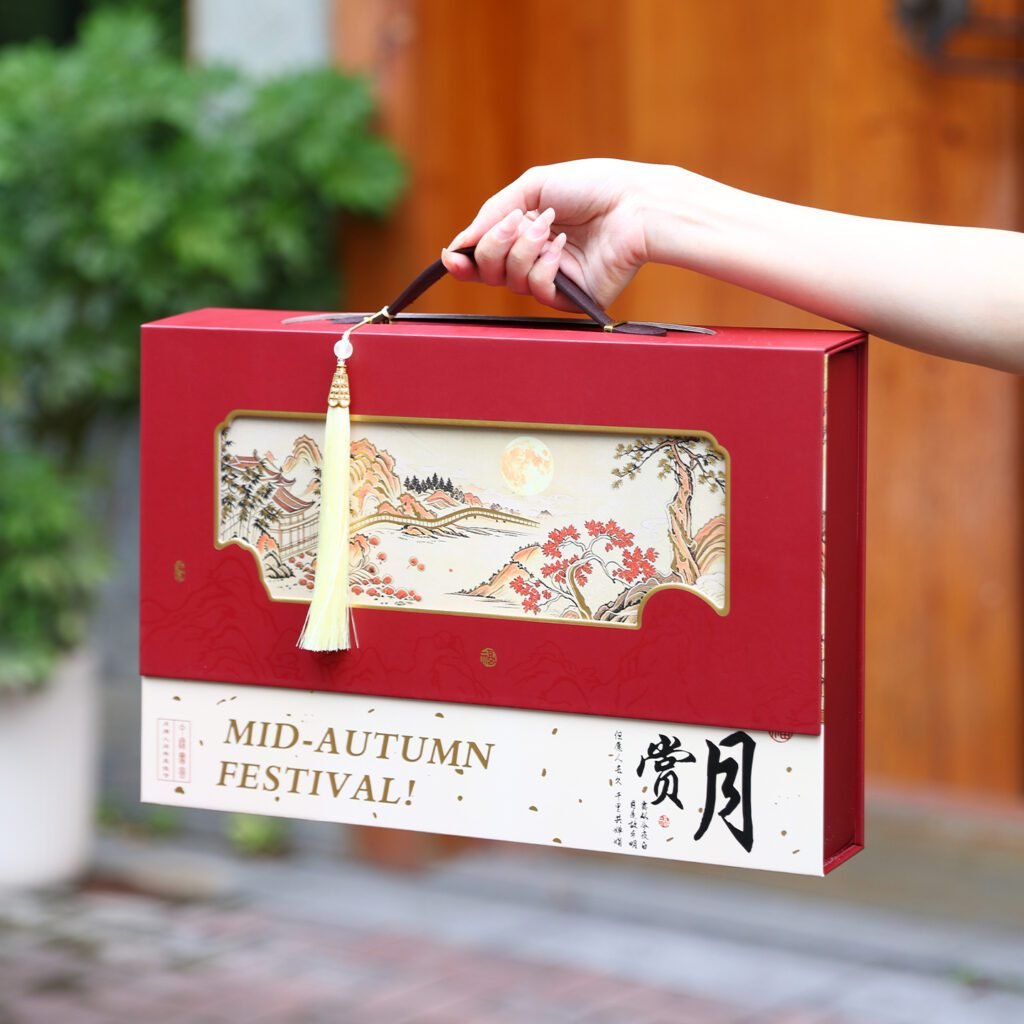
A rigid box is a greyboard core wrapped in printed paper. That is it. The whole difference in feel comes from how thick the core is.
The wall is 2.3 mm thick. 2.0 mm greyboard, wrapped in 157 gsm art paper on both faces.
That 2.3 mm is roughly five times the wall of a folding carton, and you can feel it the moment you pick the box up. More importantly, a rigid wall does not bow. At 380 mm or 420 mm on the long edge, where a folding carton lid sags, a rigid lid stays flat. If your set is 8 pieces or larger, or you want a magnetic closure, a drawer, or a two-tier insert, this is the only material that does it properly.
We run most of this work through our rigid box line, and the finish range is the widest of the four: matte or soft-touch lamination, spot UV, hot foil in gold, silver or rose gold, embossing and debossing. For premium corporate gifting this is where the budget goes and it shows.
Rigid does not have to ship assembled
This is something that most buyers are not aware of, and for sea waybills sent to Singapore, it is more effective in changing prices than exchanging materials, while also reducing storage costs
A hand-fold rigid box — also called a collapsible or fold-up rigid box — uses the same 2.0 mm greyboard and the same printed wrap as a glued rigid box. The difference is in the corners. Instead of being glued shut, the walls are scored and locked by a paper hinge and a tuck tab, so the box folds flat like a carton and opens again in about a second.
Photo: collapsible-rigid-mooncake-box-folding-design.jpg — hand-fold rigid box, folded flat and half-open. Same 1.8 mm greyboard wall as our glued construction; only the corners are engineered to fold.
What that changes, in the order it shows up on your invoice:
- A flattened hand-fold box takes roughly the volume of a folding carton. You keep the 2.0 mm rigid wall and the premium feel without paying the assembled-box volume penalty. For an 8-piece corporate order shipping to Singapore, this line is usually bigger than the entire unit-cost gap between two materials.
- Assembly labour.One second per box, no glue, no tape. A 3,000-piece order is under an hour for one person.
- Storage and second use.Fold the box back after the festival, store it flat, rebuild it next season. Your customer can do the same, which keeps the packaging in circulation far longer than a glued shell — and that is a defensible sustainability point, not a slogan.
- Sample rounds.A flat sample goes by courier at a fraction of the volume, so you can approve a structure from Singapore in days instead of weeks.
Where hand-fold does not work. The structure needs straight walls on a rectangle or square. Magnetic closures, drawer boxes, hinged lids and shaped profiles — lantern, star, heart — still have to be glued and shipped assembled. Hand-fold also gives up a little corner rigidity compared with a fully glued shell, so if the box has to survive being dropped at 2 kg, price the glued build first.
Where it fails. Two places. First, freight — and only on the glued construction. A glued rigid box arrives assembled and cannot be flattened, which is the five-times-volume problem in reverse; on sea freight to Singapore it eats the saving you thought you made on unit price. Ask for the hand-fold build and that line mostly disappears. Second, unit cost: $2.15 at 3,000 pieces for the glued construction, roughly four times a folding carton. Hand-fold sits above that because of the extra scoring, locking die and folding labour — the gap depends on structure and quantity, so ask for both quotes side by side rather than assuming.
One spec trap. Buyers ask for “1200 gsm greyboard” because they read it somewhere. Greyboard is sold by thickness in millimetres, and gsm varies with density between mills. The same 1200 gsm can arrive as 1.4 mm from one supplier and 1.7 mm from another. So a reliable supplier is still very important
A construction detail worth knowing. On a two-piece rigid box the lid needs 3-4 mm of overhang past the base, otherwise it looks like it does not fit and it drags when you open it. We build that clearance in from the dieline. If your first sample feels tight, that is the number to check.
Best for: 8 and 12-piece corporate sets, hotel and bank gifting, any box that has to survive being opened in front of a client. Ask for hand-fold if the order is large enough for freight to matter.
Tinplate (马口铁) — the one that surprises people
This is the section where the numbers stop matching intuition.
A tin mooncake box is 0.23 mm tinplate steel, litho printed on the outside and lacquered on the food-contact side. The wall is 0.28 mm thick — thinner than a folding carton.
And yet it is the strongest of the four. A 0.23 mm steel panel resists compression far better than 1.5 mm of greyboard, because the material is isotropic and the box is a closed weld. Drop a stacked tin and nothing happens. Drop a stacked rigid box and you may lose the bottom two.
And the unit cost is $0.72 at 3,000 pieces. That is below rigid, and only a few cents above kraft. Tinplate is produced in enormous volume for the food can industry, and a general-line tin box is formed on the same lines. There is almost no assembly labour in it.
So why is not every premium mooncake box a tin?
Because the unit price is not the cost. Four things sit outside it:
- The mould.A custom tin shape needs a steel draw mould, and that runs $1,500-5,000 depending on the geometry. Round and rectangular are cheap. A lantern or a star is not. That cost is real whether you order 3,000 boxes or 30,000.
- The minimum.Most tin lines will not start under 2,000-3,000 pieces. Some want 5,000. If your festival run is 1,000 boxes, tin is simply not available to you.
- The weight.A tin body weighs 3-6 times the equivalent carton. On air freight it is fatal. On sea freight it is survivable but it shifts your landed cost noticeably at volume.
- The finishing.You cannot hot foil a tin, you cannot emboss it in the paper sense, and you cannot do soft-touch lamination. Your design has to work in litho alone. That is a real creative constraint.
Food safety, if you go this route. The interior lacquer is the part that matters, not the steel. Ask for the lacquer system and the compliance documents: GB 4806 in China, FDA 21 CFR in the US, EU 1935/2004 in Europe. Many buyers now specify BPA-NI (non-intent) lacquers, which are polyester or acrylic based rather than epoxy-phenolic. Any tin supplying a food product should come with a declaration of compliance and a migration test summary. If a supplier cannot produce those, walk.
One honest note on the green claim. A tin is genuinely reusable, which is the strongest sustainability argument any packaging has. But if you drop a plastic insert tray inside it and shrink-wrap the whole thing, you have built a composite that most municipal recycling systems will not take. The tin on its own recycles well. The tin plus plastic does not. Choose one story and commit to it.
Best for: corporate collectibles, high-perceived-value gifts, brands with the volume to absorb the mould, and anything where the box is meant to be kept.
Kraft board — the honest version
Kraft board is unbleached, uncoated paperboard, usually 250-350 gsm. The wall is 0.35 mm. It is the material everyone asks about, and the one with the biggest gap between how it is marketed and how it behaves.
The good parts are real. It is genuinely more recyclable than a laminated board. It has a natural look that no printed texture reproduces convincingly. And it is honest — a brown box does not pretend to be something it is not, which is exactly why it works for the artisan end of the market.
Now the catches.
The oil problem is worse here than anywhere else. Uncoated kraft has no barrier at all. An oily mooncake sitting in a kraft cavity will mark the board through in 48-72 hours, and if the box is stacked in a warm car the marks appear on the outside face. Your options are a greaseproof paper liner between the tray and the board, a grease-resistant coated grade, or accepting the marks as part of the look. The Malaysia bakery I mentioned at the start went with a liner. It added about 6 cents per box and solved it completely.
“Eco-friendly kraft box” often means nothing. If the box is laminated matte and hot-foiled in gold, it is not recyclable. The film and the foil cannot be separated from the fibre in a standard pulping line. We see this constantly: a brand prints a recycling symbol on a laminated box. Two options — drop the lamination and foil and print in one or two colours, or keep the finish and stop claiming recyclability. Do not do both.
Colour on brown is not colour on white. CMYK artwork designed on white SBS will come out muddy and low-contrast on kraft, because the brown base absorbs and shifts everything. If you need a bright, saturated design, you need a white ink base layer first, which is an extra print pass and an extra cost per unit. Design for kraft from the start and you avoid it entirely: one or two colours, generous white space, let the board colour do the work.
We produce kraft in the same structures as our white cartons, and you can see the range on our eco-friendly kraft packaging page.
Best for: brands with a real sustainability position, 4 and 6-piece sets, mid-market gifting, and designs built for two-colour printing.
All four materials, side by side
Every figure below is for a 6-piece mooncake box with a moulded insert and full-colour printing. Unit cost is at 3,000 pieces.
|
|
Folding carton |
Rigid greyboard |
Tinplate tin |
Kraft board |
|
Wall thickness |
0.43 mm |
2.30 mm |
0.28 mm |
0.35 mm |
|
Core material |
350 gsm SBS / CCNB board |
2.0 mm greyboard + 157 gsm art paper |
0.23 mm tinplate, 2.8 g/m² tin coating |
300 gsm unbleached kraft |
|
Unit cost @ 3,000 pcs |
~$0.55 |
~$2.15 |
~$0.72 |
~$0.82 |
|
Tooling |
$80-500 die |
$80-500 die |
$1,500-5,000 mould |
$80-500 die |
|
Practical MOQ |
1,000 pcs |
1,000 pcs |
2,000-5,000 pcs |
1,000 pcs |
|
Ships |
Flat |
Flat (hand-fold) or assembled |
Nested |
Flat |
|
Crush resistance |
Low-medium |
High |
Highest |
Low-medium |
|
Moisture resistance |
Good when laminated |
Good |
Excellent |
Poor uncoated |
|
Oil / grease risk |
Medium (needs coating) |
Low |
None |
High (needs liner) |
|
Print quality |
Best |
Best |
Good (litho only) |
Limited, 1-2 colours |
|
Finish options |
Full: foil, UV, emboss |
Full: foil, UV, emboss, soft-touch |
Litho + varnish only |
Print only, if you want recycling |
|
Recyclability |
Good if unlaminated |
Fair, paper + board |
Good (tin alone) |
Best |
|
Reusable by customer |
Rarely |
Sometimes |
Always |
Rarely |
|
Best for |
4-6 pc retail, print-led design |
8-12 pc corporate, hotel |
Collectible corporate, volume |
Eco-positioned brands |
What we would actually pick
Four scenarios we handle most often, and what we quote:
A bakery doing 2,000 4-piece boxes for counter sales. Folding carton, 350 gsm, laminated, paperboard tray. Best print, best freight, lowest unit cost. Adding a tin here makes no sense — the mould alone would cost more than the whole print run.
A hotel or bank ordering 3,000 8-piece corporate sets. Rigid greyboard with a moulded insert. The box has to feel expensive in front of a client, and only rigid delivers that at this size without bowing. If the closure has to be magnetic, it ships assembled and you budget the freight. If a tuck-flap closure will do the job, ask for the hand-fold build and ship it flat — same wall, same print, carton-level freight.
A brand that wants a box people keep. Tinplate, 5,000 pieces, one simple rectangular profile to keep the mould down. Unit cost lands below rigid, the box outlives the festival, and you get a second year of brand presence on someone’s shelf. Commit to the volume or do not start.
A producer with a genuine low-waste position. Kraft board, two-colour print, no lamination, greaseproof liner. Roughly $0.88 all-in — the liner is not free — and every claim you make on the box is true.
If you are between two of these, the test is simple: put your actual mooncake, wrapped, into a sample of each, stack the boxes four high, and leave them somewhere warm for a week. Open them and look at the board. That week of testing costs nothing and it has saved more than one festival run.
Frequently asked questions
What is the most common material for mooncake boxes?
Folding carton board, usually 300-350 gsm, is the most common by a wide margin. It takes full-colour printing well, ships flat, and units land around $0.55 at 3,000 pieces. Rigid greyboard is the standard choice for 8-piece and larger premium sets, and tinplate dominates the collectible corporate end of the market.
Is a tin box or a cardboard box better for mooncakes?
For protection, tin. A 0.23 mm steel body resists crushing and moisture far better than any paperboard, and it is reusable. For cost and print flexibility, cardboard. A tin needs a 1,500-5,000 mould and a 2,000-5,000 piece minimum, while a folding carton needs a 80-500 die and 1,000 pieces. If you are ordering under 2,000 boxes, the decision is usually made for you.
Is kraft packaging actually recyclable?
Only if you leave it uncoated. Kraft board itself recycles very well. But a kraft box with matte lamination and hot foil stamping is not recyclable in a standard pulping line, because the film and foil cannot be separated from the fibre. If recyclability is your claim, keep the box unlaminated and print in one or two colours.
How thick should a rigid mooncake box wall be?
2.0 mm greyboard wrapped in 157 gsm art paper gives a finished wall of about 2.3 mm, which is our standard for 6 to 12-piece sets. Below 1.2 mm the lid starts to feel flexible on anything over 300 mm. Specify thickness in millimetres rather than gsm, because greyboard density varies between mills and the same gsm can arrive as different thicknesses.
Can a rigid mooncake box be shipped flat?
Yes, if it is built as a hand-fold — also called a collapsible or fold-up rigid box. The greyboard walls are scored and locked with a paper hinge and a tuck tab instead of being glued, so the box arrives flat, opens in about a second, and can be flattened again for storage or reuse. You keep the 2.3 mm rigid wall while paying close to carton-level freight. The limits are the shape: straight-walled rectangles and squares work, while magnetic closures, drawer boxes, hinged lids and shaped profiles still have to be glued and shipped assembled.
Can I print full colour on kraft board?
You can, but it will not look like full colour on white board. The brown base absorbs light and shifts every colour, so bright saturated artwork comes out muddy. The fix is a white ink base layer under the artwork, which adds a print pass and cost per unit. The better approach is to design for kraft from the start: one or two spot colours, generous white space, and let the board colour carry the design.
What is the minimum order for a custom tin mooncake box?
Most tin lines start at 2,000-3,000 pieces, and some require 5,000. The limiting factor is not the printing, it is the steel draw mould, which runs $1,500-5,000 and has to be amortised. If your order is below 2,000 pieces, a rigid or folding box will almost always be the better commercial decision.